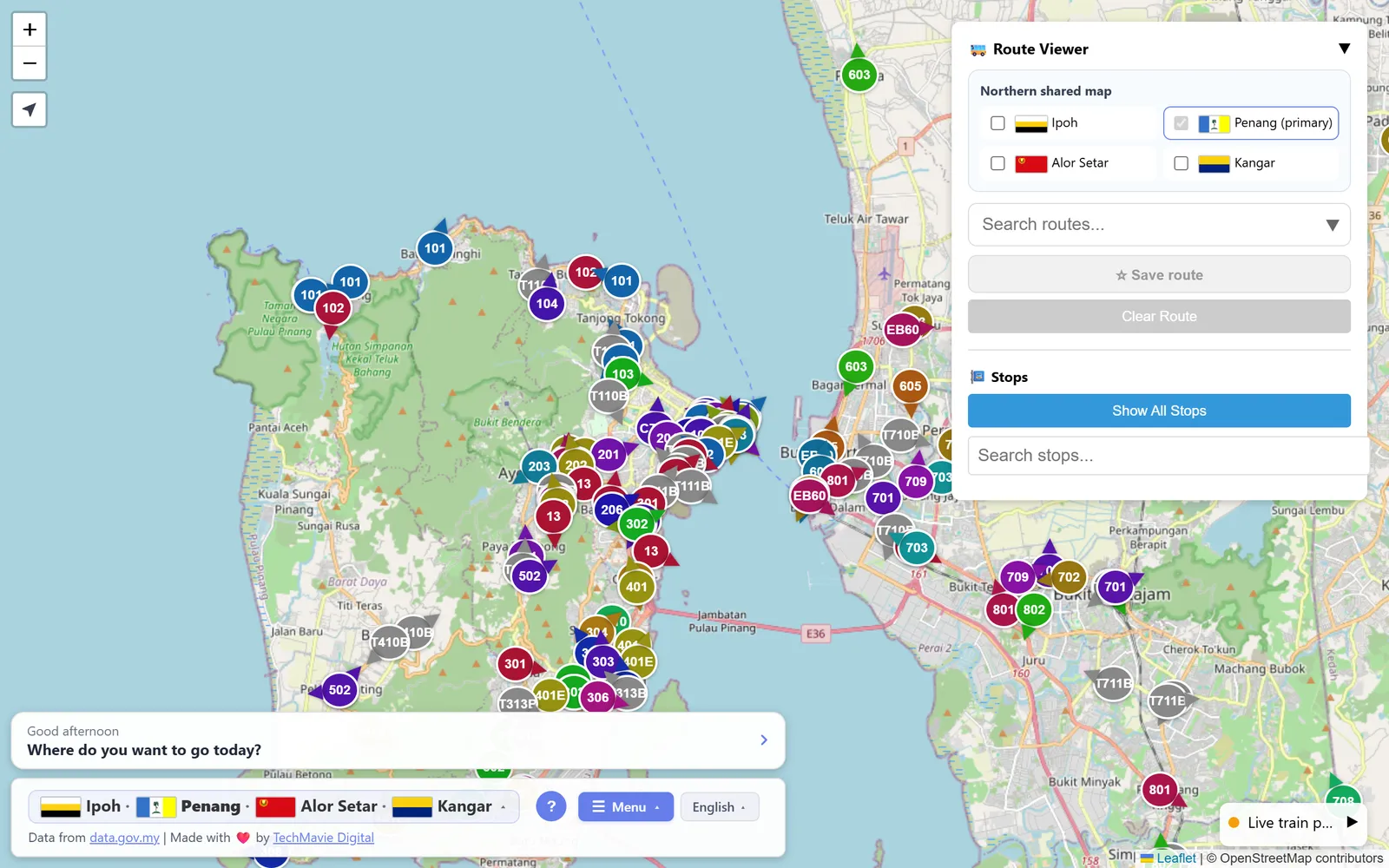
shows live buses, plus train and ferry departures, across 13 areas of Malaysia. It pulls from 18 transit providers, from Rapid KL and KTM to Penang Ferry and Causeway Link, and it works in 13 languages, including Bahasa Melayu, Chinese, Tamil and Iban. Since 26 December 2025, its free API has served more than 239,000 requests.
I built it, and I don't have a computer science degree. My degree is a Bachelor of English Studies, and for seven years I wrote content for a living.
This is how that happened, what building with AI looks like day to day, and what I do to trust something I built without an engineering background.
Before the code
In 2019 I started volunteering as a bus mapper for Moovit. I added and edited routes and timetables for Rapid Penang, Rapid Kuantan, myBAS Ipoh and Perak Transit, and fact-checked updates to keep them accurate.
At the same time, I was writing. Over seven years I wrote more than 220 articles and 400 content briefs, the briefs for Frase, an AI content platform based in Boston.
I didn't know it then, but those two habits were my training. Mapping taught me the routes and, more importantly, where the data was missing. Writing briefs taught me to explain exactly what I wanted, in enough detail that someone else could do it without me standing over them. That turned out to be the main skill in working with an AI.
By 2025 I'd spent six years improving other people's transit data. In September 2025 I set up TechMavie Digital, my own software studio, and two months later I started building my own app.
The problem
Malaysia does have open transit data. data.gov.my publishes GTFS feeds, the standard format for timetables and live vehicle positions. But the data is split across providers, and in the Klang Valley it has to be merged from several sources before it makes sense as one picture.
Some operators publish nothing at all. For services like KLIA Ekspres, Penang Ferry, and Causeway Link, there's no open feed to download, so I build those timetables myself, by hand.
The goal was easy to say: one app that shows what's coming, wherever you are in Malaysia, in your own language.
Day one
The backend's history starts on 6 November 2025. One of that day's first commits reads transform to multi-area Malaysia transit system. The next day, 7 November, I started the MCP server, so AI assistants could use the same data.
Then came December, with 203 commits. In one week, from 7 to 10 December, I added:
- fare calculators for BAS.MY and Rapid Penang, including trips with several changes
- an English and Bahasa Melayu language toggle
- an analytics dashboard for the API
- KTM trains and the Penang Ferry
Show the numbers as a table
| Month | Commits |
|---|---|
| November 2025 | 44 |
| December 2025 | 203 |
| January 2026 | 0 |
| February 2026 | 58 |
| March 2026 | 18 |
| April 2026 | 33 |
| May 2026 | 183 |
| June 2026 | 36 |
| July 2026 | 5 |
| August 2026 | 8 |
| September 2026 | 1 |
| October 2026 | 38 |
| November 2026, to the 22nd | 121 |
| Total | 748 |
Counted from the backend's git history on 22 November 2026.
The pace isn't constant. May 2026 had 183 commits, September had one, and January had none at all. As of 22 November 2026, the backend has 748.
What building with AI looks like
Of those 748 commits, 368 carry a Co-Authored-By: Claude line. That's the honest picture: a lot of this code was written with an AI.
What the AI doesn't do is decide what to build, or tell me whether the result is right. That part is mine. My loop looks like this:
- Describe the change the way I'd write a content brief: what it's for, who uses it, what “done” looks like, and what must not break.
- Let the AI draft the code.
- Check the result against reality: a real route, a real timetable, a bus I know.
- Add or update tests, then ship.
One evening in December
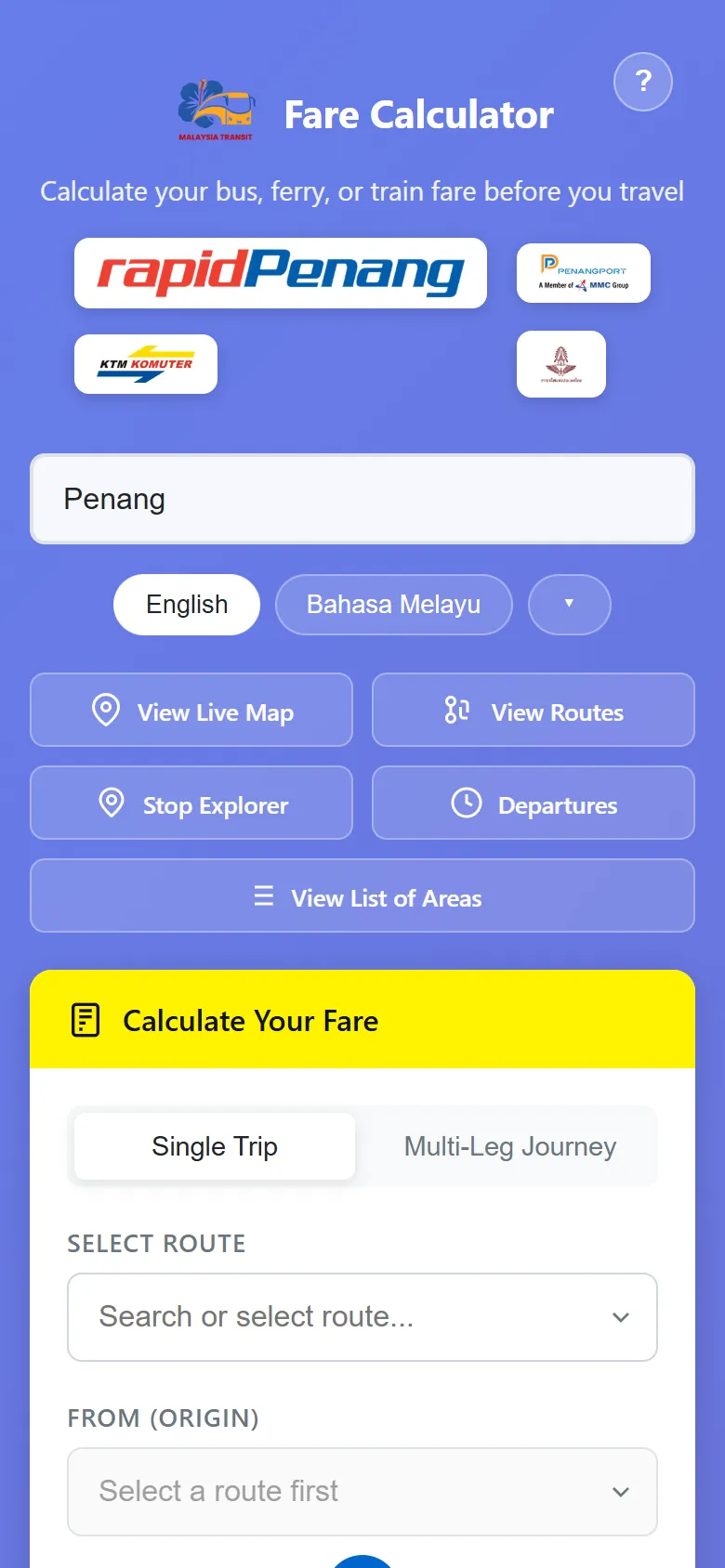
Fares are a good example. On the evening of 7 December 2025 I started with BAS.MY, which charges by distance, so the first version measured that distance along the bus route itself, not in a straight line. Two hours later it covered every BAS.MY area, with a fallback for routes without shape data. Just after 10 pm, Rapid Penang had a calculator of its own, and it works differently: fares go by stages, and one trip can take several buses.
Small things came up along the way. At 10:21 pm, a fix so iPhones stopped zooming in whenever you tapped a drop-down. The next morning, a direction selector and the free CAT routes. That's the loop in practice: lots of small steps, each one easy to check.
Fares are also where checking matters most, because a wrong fare costs someone money. Today the rail fare tables record where each one came from and the date it was checked, and the tests hold known fares from the operators' own published tables: KL Sentral to Batu Caves on the KTM Komuter has to come out at RM2.60, or the tests fail.
Arrival times, measured along the route
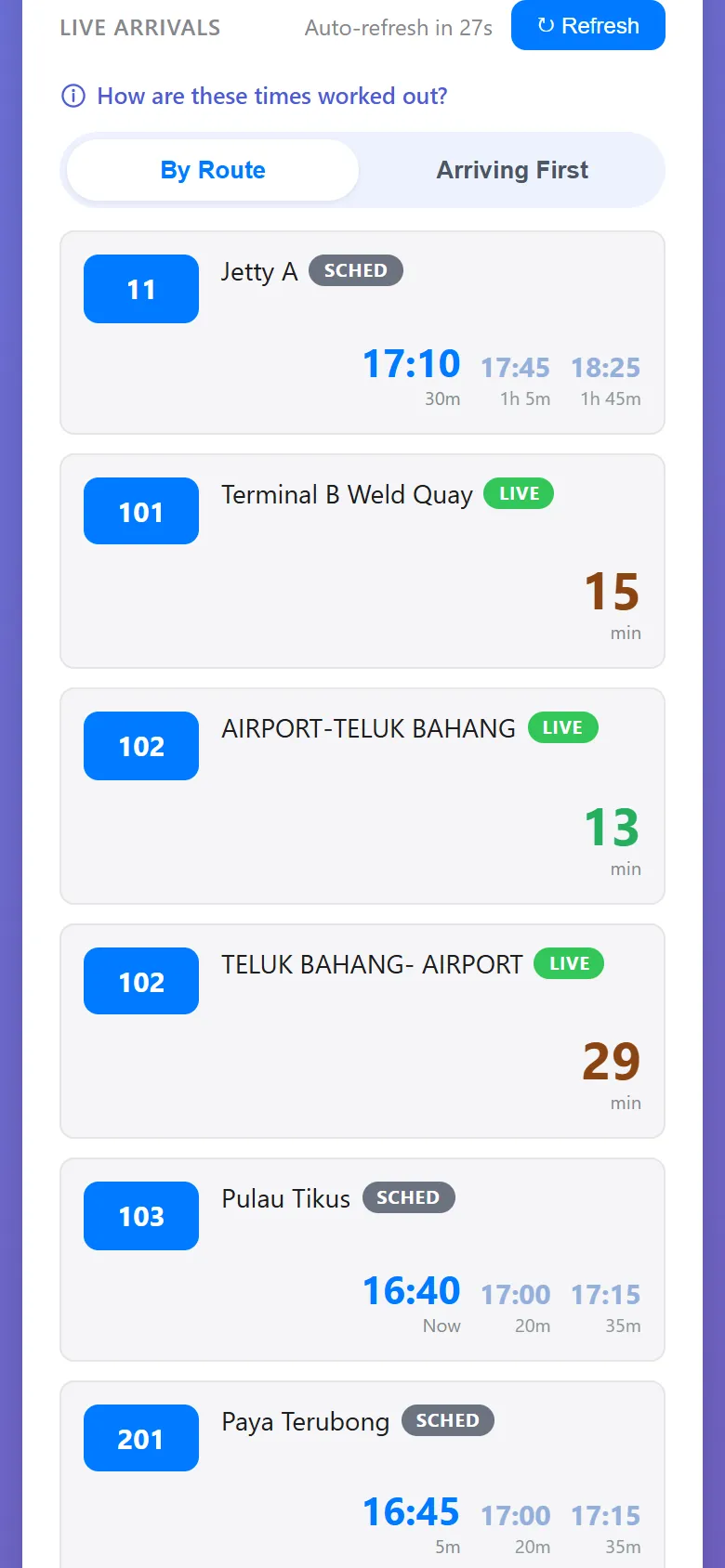
Arrival times show the idea well. A naive estimate measures the straight-line distance between a bus and your stop, but buses don't drive in straight lines. So Malaysia Transit measures the distance along the route's actual shape, from the GTFS data, and adjusts for the time of day: rush hour (7 to 9 am and 4 to 7 pm) is treated as 40 to 45% slower, and midday as 15% slower.
Every estimate also says how far to trust it:
- High: measured along the route, with the bus within 50 m of it
- Medium: measured along the route, with the bus 50 to 200 m away from it
- Low: a straight-line fallback, used when there's no route shape
A response looks like this:
{
  "routeShortName": "301",
  "destination": "Komtar",
  "vehicleId": "PKX1234",
  "etaMinutes": 18,
  "distance": 6500,
  "calculationMethod": "shape-based",
  "confidence": "high",
  "timeFactor": 0.6
}
The project's documentation puts the gain at 40 to 60% more accurate than straight-line estimates.
Making it trustworthy without a CS degree
Without a CS degree, I can't rely on instinct to spot bad code, so I rely on checks.
- Tests. By June 2026 the backend had 407 automated tests, and all of them passed. It has 94 test files now.
- Checking data before it goes live. New GTFS data is validated before it replaces the old, with a rollback if something's wrong. A broken feed from one provider shouldn't break the app.
- Honest estimates. The confidence levels exist because a wrong arrival time does more harm than an uncertain one.
- Fares done properly. Each operator charges differently, so each has its own model: BAS.MY by distance, Rapid Penang by fare stages, and KTM Komuter Utara by zones across its 23 stations.
None of this is exotic engineering. It's the same instinct as fact-checking an article before it goes out.
Opening it up
Once the app worked, I opened up the data behind it.
- A free API. Anyone can , with no payment or subscription; only operational rate limits apply. Since 26 December 2025 it has served more than 239,000 requests.
- MCP servers. These let AI assistants read live transit data, so a chatbot can answer “when's my bus?” with real information. I now run , some my own and the rest open-source servers I deploy and host, covering live transit and Malaysian and Singaporean open data.
- New apps, built the same way. , started in March 2026, shows Singapore and Johor Bahru in one real-time view, with fares in SGD and MYR and MRT crowd levels. , started in October 2026, covers Hat Yai's EV City Loop, the airport minibus and the SRT trains to Padang Besar, in Thai, English and Malay.
People have noticed. Malaysia Transit has had eight independent positive comments on Threads, and you can .
What I'd tell other builders without a CS degree
- Know the domain first. More than six years of bus mapping did more for this project than any tutorial could have. An AI can write code; it can't tell you which data is missing.
- Write for the AI the way you'd write a brief. Be specific about the goal, the user and what “done” means. Vague requests get vague code.
- Let tests be your safety net. If you can't read every line with confidence, you need checks that catch mistakes for you.
- Ship small and often, and allow quiet months. My busiest months had 203 and 183 commits. September had one, and January had none. Busy months and quiet ones are both fine.
- Respect where the data comes from. Open data made this possible. Where it doesn't exist, the slow manual work is what makes an app trustworthy.
Seven years ago I was fixing bus timetables in someone else's app, as a volunteer. Now I run my own, and the data behind it is free for anyone to build on.